目录Contents
为什么有这个项目Why this project exists
星系把失踪的重子藏在哪?Where do galaxies keep their missing baryons?
宇宙学标准模型能精确预言一个星系应该有多少普通物质(重子,baryons)。但把星系里所有的恒星、气体、尘埃加起来,只找到预期的一小部分——其余的重子应该在星系外围的星系周介质(circumgalactic medium, CGM)里:温度约 10⁶–10⁷ K 的稀薄电离气体,延伸到几十万秒差距(virial radius 量级)。它太难看到:密度低到每立方厘米只有 10⁻³ 个粒子,只能靠软 X 射线(0.3–2 keV,主要是 0.6 keV 附近的 O VII/O VIII 线与连续谱)或紫外吸收线探测。CGM 是「星系生态」的关键一环——气体会流入形成恒星,又被超新星与活动核抛出到晕里。
The standard cosmological model predicts precisely how much ordinary matter (baryons) a galaxy should contain. Yet adding up all the stars, gas and dust finds only a small fraction of it — the rest should live in the circumgalactic medium (CGM): thin ionised gas at roughly 10⁶–10⁷ K, extending to hundreds of kiloparsecs (of order the virial radius). It is very hard to see: densities of order 10⁻³ particles per cubic centimetre, detectable only in soft X-rays (0.3–2 keV, mainly O VII/O VIII lines near 0.6 keV plus continuum) or in UV absorption. The CGM is a key link in the "galaxy ecosystem" — gas flows in to form stars and is thrown out to the halo by supernovae and active nuclei.
为什么是 M31?Why M31?
要「逐视线」分辨 CGM 的空间结构,需要把大量视线铺在一个星系周围,并且每条视线离星系中心的距离可分辨。M31 距离约 785 kpc:XMM-Newton 的一步视场(约 30 arcmin)对应约 7 kpc,所以一个 15 arcmin 半径的提取区在 10–30 kpc 半径处是真正的「分辨视线」。M31 是唯一能做到这一点的 L* 星系——更远的星系视场混在一起,银河系本身我们又身在其中没有外部视角。XMM 大项目(Legacy Programme)proposal 080073「XMM-Newton Legacy Survey of M31 Halo: Searching for the Missing Accreted Hot CGM」(PI J. Li)为此安排了 22 个指向,沿 M31 短轴(NW 与 SE 两条链)铺开,中心投影半径 10.5–30.8 kpc。
To resolve CGM spatial structure sightline by sightline, one needs many sightlines spread around one galaxy, with each sightline at a resolvable distance from that galaxy's centre. M31 is at about 785 kpc: one XMM-Newton field (about 30 arcmin across) spans about 7 kpc there, so a 15-arcmin-radius extraction region at 10–30 kpc radius is a genuinely resolved sightline. M31 is the only L* galaxy for which this is possible — for more distant galaxies the field blends together, and for the Milky Way itself we are inside it with no external view. The XMM Legacy Programme proposal 080073, "XMM-Newton Legacy Survey of M31 Halo: Searching for the Missing Accreted Hot CGM" (PI J. Li) placed 22 pointings for exactly this purpose, spread along the M31 minor axis (a NW and a SE chain), with centre projected radii 10.5–30.8 kpc.
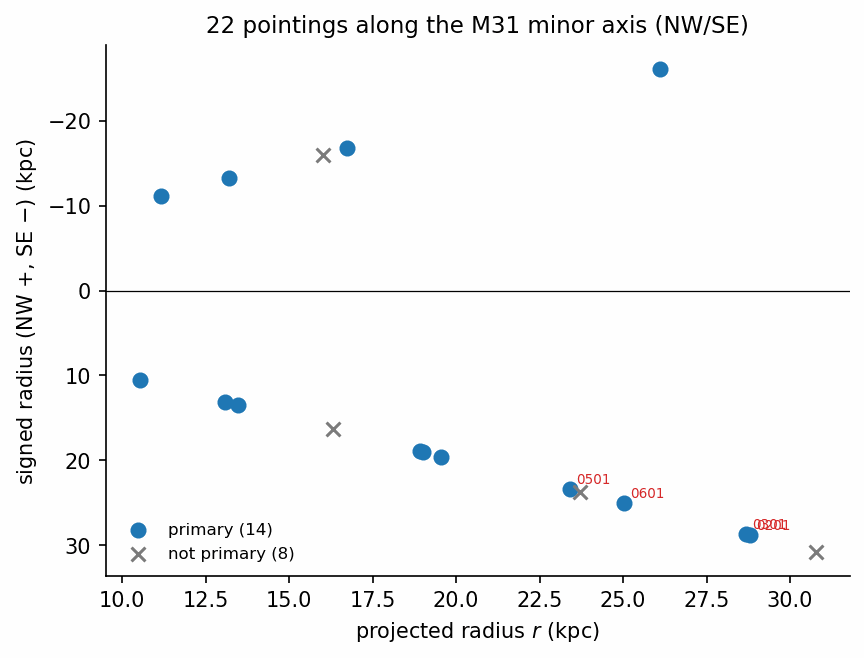
数据:independent_cgm_results_v19_.../independent_cgm_v19_all22_measurements.csv(22 行,含 rproj_kpc 与 signed_rproj_kpc);图由 handbook/hermes_figscripts/make_figures.py 生成。
Data: independent_cgm_results_v19_.../independent_cgm_v19_all22_measurements.csv (22 rows, with rproj_kpc and signed_rproj_kpc); figure made by handbook/hermes_figscripts/make_figures.py.
New-ANGELS 系列The New-ANGELS series
本项目的论文是 New-ANGELS III(「An XMM-Newton View of the ANdromeda Galaxy as Explored in a Legacy Survey」系列):
This project's paper is New-ANGELS III (the "An XMM-Newton View of the ANdromeda Galaxy as Explored in a Legacy Survey" series):
- Paper I(arXiv:2306.10113,2023):X 射线源表——本项目的源掩膜规则来自它(D48:用 Paper I 的掩膜闭掉「源探测/掩膜半径规则」这一提交门槛)。Paper I (arXiv:2306.10113, 2023): the X-ray source catalogue — this project's source-mask rule comes from it (D48: Paper I's mask closes the "source-detection/mask-radius rule" submission gate).
- Paper II(arXiv:2511.05856,2025):X 射线源光度函数——用于扣除极限以下的未解源。Paper II (arXiv:2511.05856, 2025): the X-ray luminosity function — used to subtract unresolved sources below the limit.
- Paper III(本项目):M31 内晕方向的弥漫软 X 射线发射(CGMsum 测量与空间限制)。Paper III (this project): diffuse soft X-ray emission toward the M31 inner halo (the CGMsum measurement and spatial limits).
来源:cognition-os/04_DECISION_LOG.md D48(系列与 PI 论文);paper_apj_v19_cgmsum_draft/README_draft_status_and_submission_gaps.md「Title options」。
Source: cognition-os/04_DECISION_LOG.md D48 (the series and the PI's papers); paper_apj_v19_cgmsum_draft/README_draft_status_and_submission_gaps.md "Title options".
核心困难:银河系前景就在同一条视线上The central difficulty: the Milky Way foreground lies in the same sightline
M31 方向上的软 X 射线发射 = 银河系自己的热晕与本地热泡(前景)+ M31 的 CGM(目标)+ 更远的宇宙背景。麻烦在于:银河系热晕气体的温度(kT ≈ 0.17–0.2 keV)与 M31 CGM 的温度(本项目测得共温 kT = 0.17531 ± 0.00436 keV)几乎相同,吸收与丰度也相同——两条谱形状几乎共线。M31 系统速度只把 O VII 线移动约 0.6 eV,而 MOS 在该能量的分辨率约 50 eV,所以 EPIC 谱完全无法用速度区分距离(I006)。分解只能来自空间:M31 分量应随到 M31 中心的半径衰减(β 模型),银河系分量应随银纬梯度变化。这就是本项目「先测总和 CGMsum,再用轮廓形状限制 M31 分量」的设计。
Soft X-ray emission toward M31 = the Milky Way's own hot halo and Local Hot Bubble (the foreground) + M31's CGM (the target) + the distant cosmic background. The trouble: the MW halo gas temperature (kT ≈ 0.17–0.2 keV) is nearly the same as the M31 CGM temperature (this project measures a common kT = 0.17531 ± 0.00436 keV), with the same absorption and abundance — the two spectra are almost collinear. M31's systemic velocity shifts the O VII complex by only about 0.6 eV while MOS resolves about 50 eV there, so EPIC spectra have essentially no velocity leverage on distance (I006). Separation can only come from space: an M31 component should decline with radius from the M31 centre (a beta model), while the MW component should follow the Galactic-latitude gradient. Hence this project's design: measure the sum CGMsum first, then limit the M31 component by profile shape.
来源:cognition-os/insights/I006(0.6 eV vs 50 eV、共线性、五条出路);kT 来自 cognition-os/insights/I012。
Source: cognition-os/insights/I006 (0.6 eV vs 50 eV, collinearity, the five escape routes); kT from cognition-os/insights/I012.
4. 动画:天空草图——两种对称假设4. Animation: the sky sketch — two symmetry hypotheses
22 个指向(红 = 偏亮的外 NW 四场;蓝 = 其他主样本;灰 = 非主样本)铺在 M31(椭圆)旁。切换两种对称假设,看「M31 镜像」与「银纬镜像」分别把外 NW 四场映到哪里——本项目正是用这种几何差异区分 M31 晕与银河系前景(I033 第 7 条)。注:E014 已用 RASS 独立历元检验,大尺度银纬结构未能复现外 NW 的超出(D49)。
The 22 pointings (red = the bright outer-NW four; blue = other primary fields; grey = non-primary) sit beside M31 (the ellipse). Toggle the two symmetry hypotheses to see where "M31 mirror" and "latitude mirror" each map the outer-NW four — this geometry is exactly how the project distinguishes an M31 halo from the MW foreground (I033 item 7). Note: E014 tested this against the independent RASS epoch, and large-scale latitude structure did not reproduce the outer-NW excess (D49).